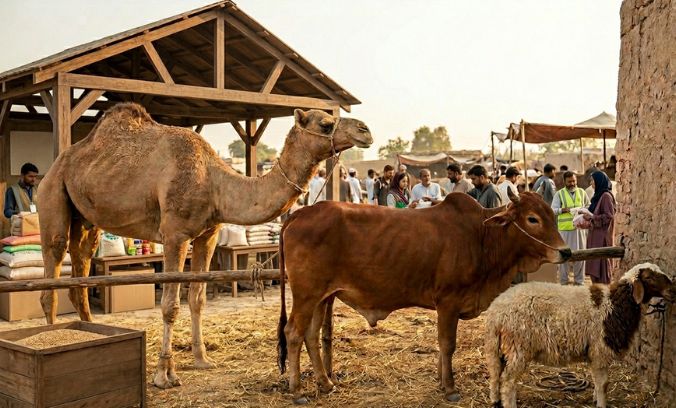
As the best ten days of the year begin, many Muslims face a common dilemma: which animal should I choose for my sacrifice? While the act of Qurbani is deeply spiritual, the practical side—budget, animal size, and the amount of meat provided to the poor—is a major consideration for many families. Whether you are looking for the most affordable qurbani for eid or you want to ensure your donation feeds as many people as possible, understanding the difference between animal types is key. In this “Deep Dive,” we compare sheep, cows, and camels to help you decide which qurbani shares in cow or other livestock provide the most impact for your donation.
1. The Small Animal: Sheep and Goats
For many, a sheep or a goat is the traditional choice. In the Sunnah, the Prophet (PBUH) often sacrificed two rams.
- Share Value: One sheep or goat equals one full Qurbani. It cannot be split between multiple people.
- Impact: A single small animal typically provides enough meat to feed about 5 to 10 families a single, nutritious meal.
- Best for: Individuals who want to perform a full sacrifice in their own name or those who prefer the traditional, prophetic practice of offering a whole animal.
2. The Large Animal: Cow and Buffalo
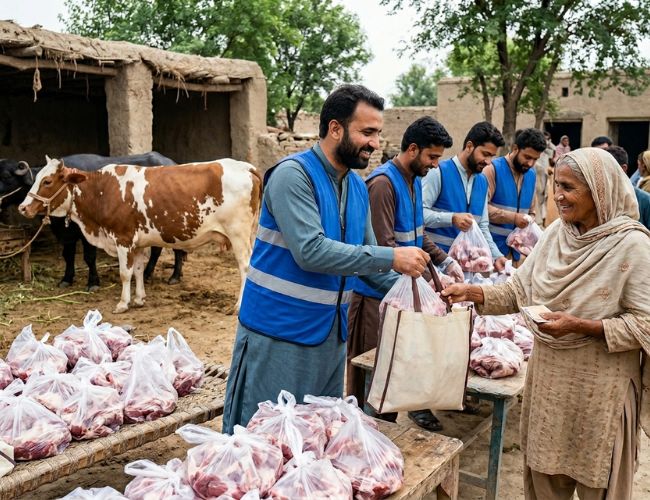
Cows and buffaloes are the most popular choices for those looking for affordable qurbani for eid. This is because they allow for the “share” system.
- Share Value: A cow or buffalo represents seven individual shares. You can purchase one share or all seven.
- Impact: A full cow provides a massive amount of meat—often hundreds of kilograms. A single share (qurbani shares in cow) can feed significantly more people than a small goat because of the higher meat-to-bone ratio in larger livestock.
- Cost-Effectiveness: Often, a single share in a cow is more affordable than buying a whole sheep, making it the perfect option for those on a budget who still want to fulfill their obligation.
3. The King of Sacrifices: Camel Qurbani
In many parts of the world, particularly in the Middle East and parts of Africa, the camel is considered the ultimate sacrifice. It is a large, hardy animal that provides an incredible amount of sustenance.
- How many shares in camel qurbani? Just like a cow, a camel consists of seven shares.
- Camel qurbani how many shares for my family? If you have a large family, you might choose to take all seven shares, or you can simply donate one share to be part of a larger sacrifice.
- Impact: A camel is significantly larger than a cow. The nutritional yield is immense. One camel can provide enough meat to feed an entire small village or a large refugee camp for a day.
- Symbolism: Choosing a camel is often seen as an act of great generosity because of the sheer volume of food it provides to the hungry.
4. Comparing the Impact: Which Should You Choose?
When deciding how to allocate your qurbani donation online, consider the following comparison table:
| Animal Type | Total Shares | Best For | Meat Yield (Avg) |
| Sheep / Goat | 1 Share | Individual Sunnah | 15 – 25 kg |
| Cow / Buffalo | 7 Shares | Families & Value | 150 – 250 kg |
| Camel | 7 Shares | Maximum Impact | 300 – 500 kg |
If your goal is purely to feed the maximum number of people for every pound spent, qurbani shares in cow or camel are often the most efficient. Because these animals are larger, the “cost per kilogram” of meat delivered to the poor is usually lower than that of a sheep or goat.
5. How to Give Qurbani Correctly with Children of Adam
Regardless of which animal you choose, the most important factor is that the sacrifice is performed correctly. At Children of Adam, we ensure that:
- Every animal meets the specific age requirements (e.g., 2 years for cows, 5 years for camels).
- The livestock is healthy and free from defects.
- The meat is distributed to those who are truly in need in Palestine, Yemen, Pakistan, and Kenya.
By choosing a qurbani donation online through us, you are making sure that your share—whether it is a small goat or a share in a large camel—is handled with the utmost respect for Shariah and humanitarian standards.
Frequently Asked Questions (FAQs)
How many shares in camel qurbani are allowed?
A camel is divided into seven shares. You can purchase a single share or any number up to seven to fulfill your family’s requirements.
Is a share in a cow as valid as a whole sheep?
Yes. In Islamic law, one-seventh of a large animal (like a cow or camel) is equivalent to one whole small animal (like a sheep or goat). Both fulfill the obligation of Qurbani for one person.
What is the most affordable qurbani for Eid 2026?
Generally, a share in a cow or buffalo in countries like Pakistan or Nepal is the most affordable way to perform Qurbani while still providing high-quality meat to the poor.
Can a family of four share one goat?
No. A goat or sheep can only represent one person’s sacrifice. For a family of four, you would either need four goats or four shares in a larger animal like a cow.
How many families does a cow qurbani feed?
A full cow can provide meat for approximately 30 to 50 families, depending on the size of the animal and the portion sizes distributed. This makes qurbani shares in cow a very high-impact donation.