Turn on a tap at home and clean water flows out in seconds. We hardly think about it. But in many villages around the world, there is no tap, and every drop has to be carried from far away. A hand pump changes all of that. It gives a whole community water for drinking, cooking, cleaning and prayer. This is why many Muslims choose a water pump sadaqah jariyah gift: it is a simple act that keeps helping people long after the day you give it.
What is sadaqah jariyah?
Sadaqah jariyah means ongoing charity. It is a gift that keeps on giving, so the reward can keep growing too. The Prophet Muhammad ﷺ taught that when a person passes away, their deeds come to an end except for three things: ongoing charity, knowledge that benefits others and a righteous child who prays for them.
Wells, schools and trees are all well-known examples. A water pump fits perfectly, because for as long as people drink from it, the benefit continues, in shaa Allah.
Water in Islam
Many Muslims ask how to donate water in Islam and why it is so loved. According to a well-known narration, a companion named Sa’d ibn Ubadah asked the Prophet ﷺ which charity would be best for his mother, who had passed away. The Prophet ﷺ pointed to water, and Sa’d had a well dug in her name.
Water is also part of daily worship. We cannot make wudu without it, and wudu comes before every prayer. A village without water struggles to live well, and it also struggles to pray with ease.
A day with one hand pump
Let us follow a village day. The village is imagined, but the story is a common one.
Before sunrise: wudu and Fajr
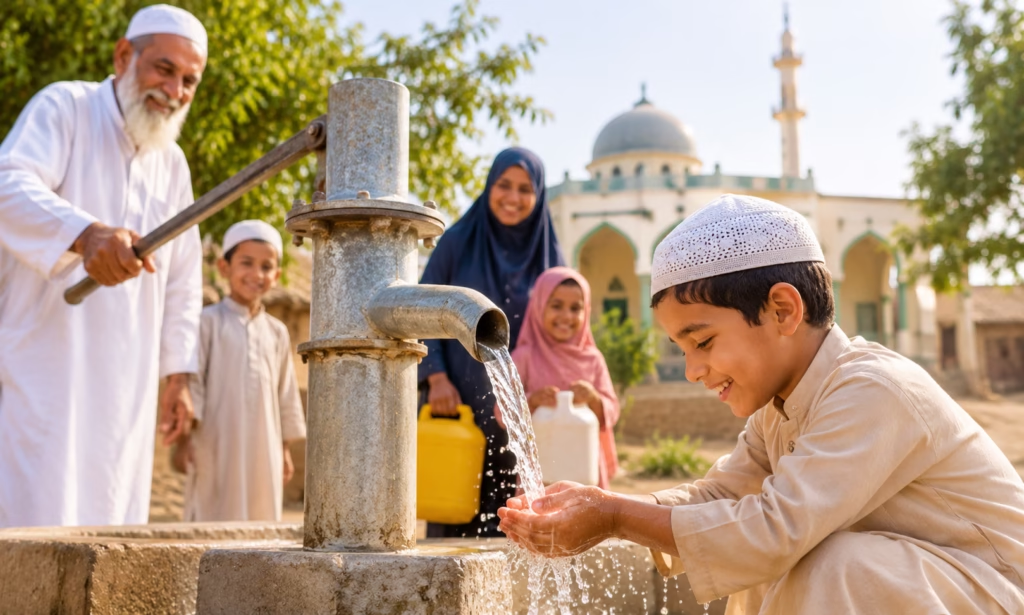
Before the pump, the women of the village walked for hours to fetch water, so wudu had to be quick and careful. Now the pump is a short walk away. Families wake, make wudu with plenty of water and pray Fajr together.
Mid-morning: drinking and cooking
Safe water makes a big difference to health. Dirty water can cause stomach illnesses, which are especially dangerous for young children. When a village has a clean source nearby, fewer children get sick, and parents spend less on medicine.
Afternoon: school and farms
When water is far away, children, especially girls, often spend hours collecting it and miss school. With a pump close to home, they can go to class. Families can also water small vegetable gardens, which gives them more food to eat and sell.
Evening: mosque and home
The local mosque uses the same water for wudu, and families use it to cook and clean. In Ramadan, the pump helps people prepare iftar and make wudu for Taraweeh.
Why a water pump sadaqah jariyah lasts so long
A hand pump is simple. It has no electricity bill and needs no fuel, so it keeps working even in places with no power. With a little care, it can serve a community for years.
The key is people. Pumps keep running when the community looks after them, which is explained well in this article on how communities keep water projects running. Local people are often trained to do simple repairs, so a small problem does not become a big one.
Why water matters in Pakistan
Many rural communities in Pakistan live far from safe water. Families sometimes rely on distant or unsafe sources, and children can spend precious hours collecting it. When you donate a water pump in Pakistan, you help a village that might otherwise go without, and the reward continues for as long as the pump is used.
How to give a water pump
Giving is easier than many people think. Here is how it usually works:
- Choose the project. A water hand pump donation provides a pump that a whole community can use. A water project donation may also cover other water needs.
- Give online. You can donate a water hand pump online in a few minutes, from home.
- Give in someone’s name. Many families give in memory of a loved one who has passed away.
Before you give, check that your clean water charity explains where the pump will be built, how much it costs and how it will be looked after. A good charity will also share updates.
A water pump sadaqah jariyah is a gift that touches wudu, health, school, farming and family life all at once. One pump, one village and a reward that keeps flowing.
What will your water leave behind?
Here is a question to take with you: what would you like your giving to leave behind? If the answer is clean water, healthy children and easy wudu for a whole village, the team at Children of Adam can help you start. Its Water Hand Pumps appeal supports communities without safe water, and it follows a 100% donation policy for sadaqah, zakat and lillah. Reach out with your questions, and turn one gift into a source of water for many.
Frequently asked questions
Can I donate a pump for someone who has passed away?
Many scholars say sadaqah can be given on behalf of someone who has passed away, and the story of Sa’d ibn Ubadah is often given as an example. Ask a scholar if you want guidance for your own situation.
Can I use zakat to build a water pump?
Scholars generally say zakat must go to eligible people rather than to building projects, so water pumps are usually funded from sadaqah. Check with the charity which fund your gift will use.
How long does a hand pump last?
It depends on how often it is used and how well it is cared for. With regular care and local repairs, a hand pump can serve a community for many years.
Can I give part of the cost?
Many charities let you give any amount towards a pump. Ask the team whether shared donations are possible.