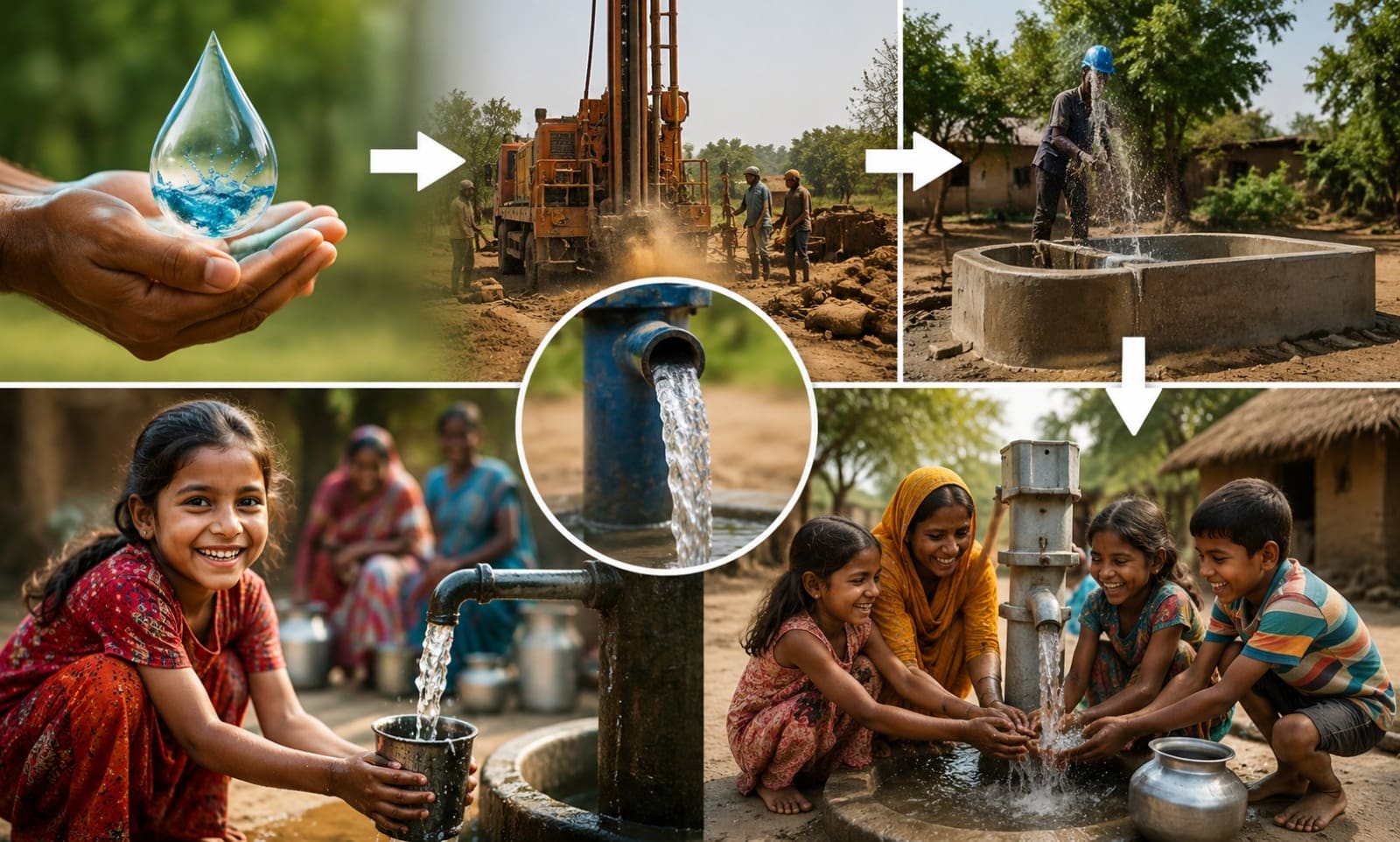
For families living in urban areas, clean drinking water is as simple as turning on a tap. However, across countless remote, water-stressed regions worldwide, obtaining water is a daily battle for survival. During the sacred month of Muharram, many donors choose to make an Islamic water well donation to permanently break this cycle of poverty.
But what actually happens after you click “donate” online? Building a reliable, long-term water asset is an intense engineering and social process. It requires careful geological planning, skilled manual labor, and active community participation to ensure the water remains safe for decades.
This article takes you completely behind the scenes of a community water pump project. You will see how your donation travels from an initial digital transaction to a fully operational, life-changing asset in a remote village, and how this work links deeply to major historical events in Islamic history.
The Spiritual Anchors: Sacred Water Lessons from Muharram History
To truly understand why providing clean water is so vital, and why launching a Muharram charity initiative carries such immense weight, we must look at the profound historical events that occurred during this sacred month. Water holds an immense physical and symbolic status in Islamic history, which is why a dedicated Muharram donation for clean water projects becomes so meaningful during these two major historical milestones:
Prophet Musa (AS) and the Liberation from Tyranny
On the 10th day of Muharram—the Day of Ashura—Allah miraculously parted the waters of the Red Sea to save Prophet Musa (Moses) and the Children of Israel from the chasing army of Pharaoh. Water was used by divine decree as a tool of absolute liberation, safety, and survival for an oppressed nation.
The Trial of Thirst at the Battle of Karbala
In stark contrast, the 10th of Muharram in the year 61 AH witnessed a profound tragedy where water was weaponized. On the burning plains of Karbala, Imam Hussain (the beloved grandson of the Prophet Muhammad, peace be upon him), along with his immediate family and small group of companions, was cut off from the nearby Euphrates River by a massive opposing army.
For days, young children, women, and warriors faced agonizing, severe thirst before their ultimate martyrdom.
When a donor funds a clean water initiative during Muharram, they are directly responding to this historical memory. By relieving a vulnerable family from the pain of thirst today, you turn historical reflection into a proactive, life-giving legacy.
Step-by-Step: The Technical Water Well Installation Process
Deploying a successful rural water pump project moves through five distinct physical phases. Every single phase must be executed with absolute precision to protect the structural integrity of the project.
[Phase 1: Hydrogeological Survey] ➔ [Phase 2: Deep Bore Drilling] ➔ [Phase 3: Casing & Flushing] ➔ [Phase 4: Casting the Apron] ➔ [Phase 5: Quality Testing]
Phase 1: Hydrogeological Surveying and Site Selection
Before any digging begins, ground teams conduct extensive underground water table surveys. It is not enough to just find water; engineers must locate a sustainable aquifer (an underground layer of water-bearing rock) that will not dry up during harsh summer droughts. Teams also ensure the site sits a safe distance away from local primitive sewage systems to avoid underground contamination.
Phase 2: The Water Well Installation Process and Drilling
Once a safe location is locked in, the heavy drilling begins. For a standard household asset, workers use manual percussion drilling rigs to cut deep into the earth. For large-scale community assets, heavy machinery bores hundreds of feet down into the bedrock to access pure, clean water reserves.
Phase 3: Pipe Casing and Well Flushing
As the hole is bored, high-durability PVC casing pipes are dropped down to line the well walls, preventing the surrounding soil from collapsing inward. Once the target depth is hit, the well is thoroughly flushed to clear out muddy drilling fluid, silt, and sand until the water runs completely clear.
Phase 4: Constructing the Concrete Apron
The mechanical pump mechanism is fitted onto the internal pipes. On the surface, masonry teams construct a thick, wide concrete pad called an apron around the base of the pump. This slanted concrete barrier is absolutely vital; it prevents surface wastewater, dirt, and animal waste from pooling around the pump head and seeping back down into the clean water supply.
Phase 5: Rigorous Water Safety Testing
Before the community ever drinks from the asset, chemical and bacterial water testing is conducted. This confirms the water is completely free from harmful levels of naturally occurring arsenic, fluoride, and lethal bacteria, ensuring it is 100% safe for consumption.
Human Impact: How a Clean Water Project Transforms a Rural Community
The physical installation of a water asset does far more than just improve hydration. Executing a comprehensive clean water project in rural communities permanently transforms the structural fabric of local society in two massive ways:
1. Eliminating Waterborne Disease and Improving Village Health
In remote regions, families are often forced to collect water from open ponds, rivers, and shallow uncovered wells that are shared with livestock. This water is heavily contaminated, leading to chronic outbreaks of deadly waterborne illnesses like cholera, typhoid, and severe dysentery.
Installing a sealed, deep-bore water system delivers pristine, filtered water directly to the heart of the village. Within weeks of an installation, local medical clinics report massive drops in water-related illnesses, especially among young children and infants who are most vulnerable to dehydration.
2. Restoring Dignity, Education, and Security for Women and Girls
In rural areas, the burden of collecting water falls almost entirely on women and young girls. They are forced to walk miles every single day carrying heavy clay pots under extreme heat. This grueling task carries major social costs:
- Loss of Education: Young girls miss school entirely because their mornings and afternoons are consumed by fetching water.
- Severe Physical Injury: Carrying heavy loads over long distances causes permanent spinal alignment damage, pelvic issues, and chronic joint pain.
- Safety Vulnerabilities: Walking alone through isolated, remote terrains leaves women highly vulnerable to physical harassment and wildlife encounters.
Bringing a professional water pump installation in rural areas directly into a village neighborhood reduces the daily walk to just a few steps. It restores safety, gives young girls their time back to attend school, and allows women to pursue small economic activities to uplift their households.
Realizing Lasting Relief with Children of Adam
Building sustainable, long-term water infrastructure requires an experienced partner who understands both engineering and grassroots community needs. Children of Adam is a prominent, UK-registered international charity (Charity Commission Registration Number: 1153244) with years of experience executing professional water infrastructure projects across Asia, Africa, and the Middle East.
Operating under a strict 100% donation policy for humanitarian projects, Children of Adam ensures that every single pound you donate goes directly into purchasing physical materials, paying local construction teams, and testing water safety.
Conclusion: Turning Your Donation into a Flowing Legacy
Investing in a rural water initiative is one of the most powerful, sustainable humanitarian choices you can make. By understanding the deep technical care that goes into everything from site selection to water testing, you can see that your contribution creates an enduring foundation for human life.
During Muharram, as we remember the historical lessons of liberation under Prophet Musa (AS) and the intense trials of thirst at Karbala, providing water allows us to transform our faith into tangible action. Partnering with a trusted, transparent charity like Children of Adam ensures that your seasonal gift becomes a permanent source of life, health, and dignity for thousands of vulnerable people.
Frequently Asked Questions (FAQ)
What is the core difference between a family hand pump and a community tube well?
A family hand pump is a shallow-to-medium depth well designed to support 2 to 3 households in immediate proximity. A deep-water community tube well uses heavy mechanical boring to reach deep underground aquifers, supplying clean water to entire villages, local schools, religious spaces, and livestock.
How does Children of Adam select the locations for these water projects?
Locations are chosen based on rigorous needs-assessments conducted by field teams. They prioritize isolated, low-income rural areas that have no existing clean water access, high rates of waterborne illnesses, and where women must travel long distances daily to find water.
Can I dedicate a water pump project in the name of a loved one?
Yes. When setting up your donation online, you can provide a specific name to be printed onto a permanent metal plaque attached directly to the concrete base of the pump. This serves as a beautiful form of ongoing charity (Sadaqah Jariyah) for deceased parents or family members.
How long does the physical water well installation process take from start to finish?
On average, a complete installation takes anywhere from a few weeks to a couple of months. This timeline depends heavily on regional weather conditions, ground terrain complexity, transit times for drilling equipment into remote locations, and the time required for proper concrete curing and lab water testing.
How do we ensure that the water pump does not break down over time?
Children of Adam focuses on long-term sustainability by using heavy-duty, locally sourced parts that can easily be repaired on the ground. By establishing a local maintenance committee and teaching village elders basic repair techniques, the community takes ownership of the asset to keep it operational for decades.