The Calm Before the Storm in the Desert of Badr
The night of the 17th of Ramadan, in the second year of the Hijrah, was unlike any other night in the history of mankind. In the middle of the harsh Arabian desert, at a place called Badr, two armies had gathered, representing two entirely different futures for humanity. On one side stood the mighty Quraysh of Makkah, a force of over one thousand well-equipped warriors, brimming with arrogance and the desire to crush the infant Islamic state once and for all. On the other side stood a small band of three hundred and thirteen believers—the Sahabah—weak in numbers and poorly equipped, but radiating a faith that could move mountains.
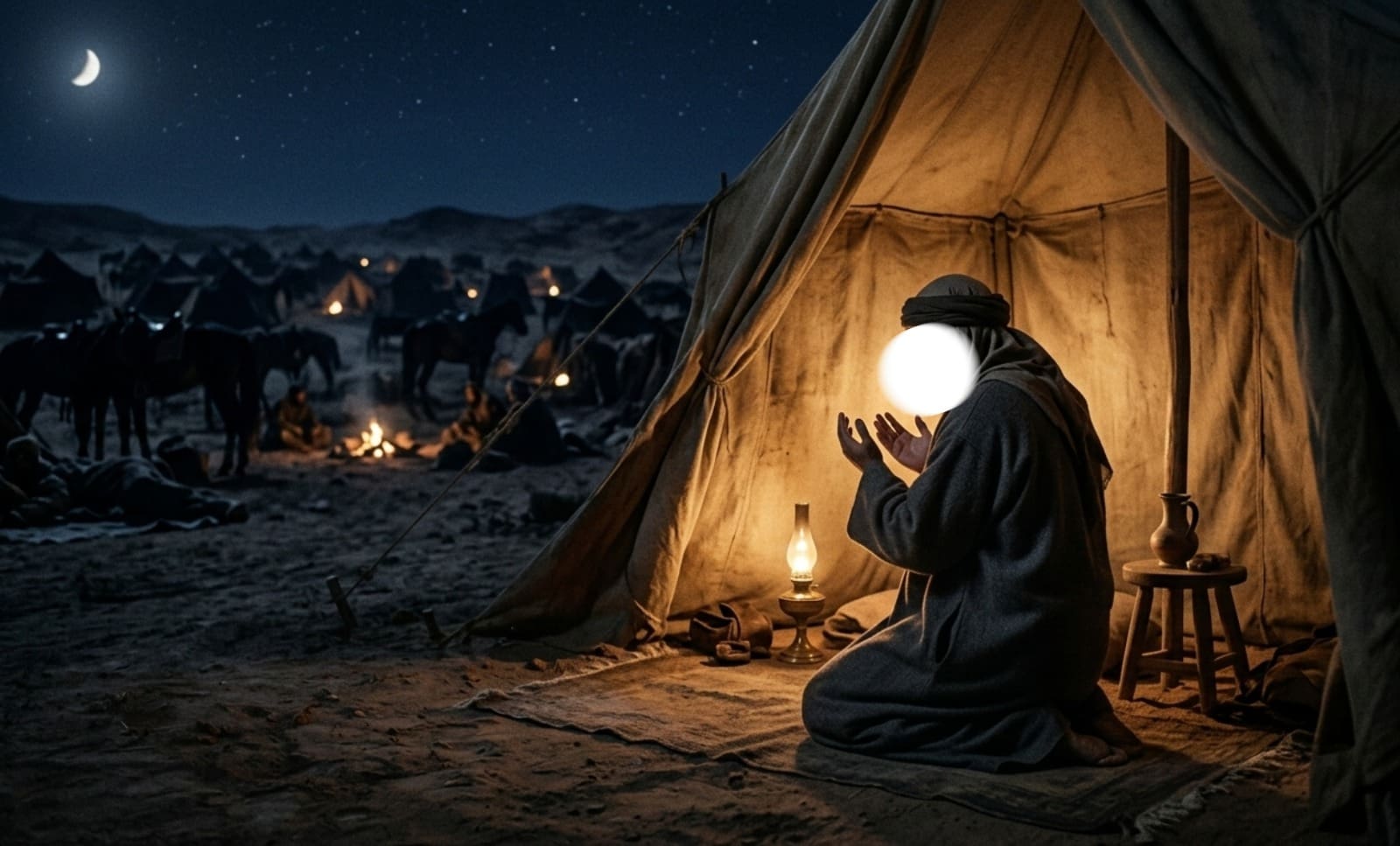
As the darkness descended upon the valley, a strange and miraculous phenomenon occurred. While the enemy camp was restless with the noise of horses and the feasting of the proud, the Muslim camp was enveloped in a divine tranquility. Allah (SWT) sent down a light rain to purify the believers and firm the sand beneath their feet, making it easier to stand. More miraculously, He bestowed upon the Sahabah a deep, refreshing sleep (Sinah) that removed their anxiety and fatigue. However, there was one who did not sleep. The leader of the believers, the Mercy to all the worlds, Prophet Muhammad (PBUH), spent the entire night in an intense state of worship, standing in prayer and crying before his Lord.
The Bower of Devotion: Prayer Under the Tree
A small shelter or bower (Areesh) had been constructed for the Prophet (PBUH) upon a small hill overlooking the battlefield. It was here, under the cover of the Ramadan night, that the real victory of Badr was won. The Prophet (PBUH) did not spend those final hours revising military maps or sharpening blades; instead, he turned his face toward the Qibla, raised his hands so high that the whiteness of his armpits was visible, and began a supplication that shook the heavens.
His dua was not merely a request for physical victory or personal safety; it was a plea for the survival of the Truth on earth. He cried out to Allah with such intensity that his heartfelt emotions manifested physically. He famously said, “O Allah! If this group (of Muslims) be defeated today, You will no longer be worshipped on the earth.” This moment highlights the immense weight of the mission. The Battle of Badr was not about territory, tribal pride, or spoils; it was the critical juncture where the future of monotheism hung in the balance. The Prophet (PBUH) stood as the bridge between the vulnerability of the 313 and the infinite power of Allah.
The Fallen Cloak and the Power of Tawakkul
The intensity of the Prophet’s (PBUH) prayer was so great that his cloak (Ridah) slipped from his blessed shoulders and fell to the ground. He was so absorbed in his conversation with Allah, so lost in his state of “Iftiqar” (utter neediness before God), that he did not even notice the garment falling. His closest companion, Abu Bakr as-Siddiq (RA), who was standing guard outside the bower, eventually entered and witnessed this heart-wrenching scene. He gently picked up the cloak and placed it back on the Prophet’s (PBUH) shoulders.
Abu Bakr (RA) embraced him from behind and whispered words of comfort, saying, “O Messenger of Allah, this prayer of yours to your Lord is sufficient. He will surely fulfill the promise He made to you.” This interaction demonstrates the core concept of Tawakkul (absolute reliance on Allah). The Prophet (PBUH) had done everything humanly possible—he had organized the men, chosen the strategic location near the water, and prepared the defenses. But he knew that human effort alone is a shell; it is only divine support that provides the spirit of victory. The falling cloak symbolized a total surrender to divine will, a moment where the leader of the Ummah showed that true power lies in being a humble servant of the Almighty.
Winning the Heart Before the Sword
The narrative of Badr teaches us that victory is won in the hearts before the first arrow is ever fired. The spiritual preparation that took place that night was the foundation of the physical bravery shown the next day. The Sahabah witnessed the Prophet’s (PBUH) devotion, and it infused them with an unshakable certainty (Yaqeen). While the Quraysh relied on their numbers and their steel, the Muslims relied on the “Arsh” (Throne) of Allah.
When the Prophet (PBUH) finally emerged from his bower as the dawn broke on that Friday, his face was radiant. He was no longer the crying supplicant; he was the confident commander, assured of divine support. He recited the verses of Surah Al-Qamar: “Their multitude will be routed and they will show their backs.” The night of Ramadan had transformed a vulnerable minority into an unstoppable force. The tears shed under that tree became the spiritual shields that protected the believers during the heat of the clash. It proves that a leader’s greatest strength is their connection to Allah, which in turn inspires the followers to achieve the impossible.
Lessons for the Modern Believer and Humanitarian
The incidents at Badr serve as a perpetual reminder for organizations like Children of Adam and the global Ummah. In 2026, we often face challenges that seem as overwhelming as the thousand-strong army of the Quraysh—extreme poverty, systemic oppression, and widespread suffering. The lesson of the Prophet’s (PBUH) night at Badr is that our first resort must always be spiritual. Before we take action, we must seek the blessing of the One who controls all outcomes.
True empowerment comes from recognizing that we are never alone when we stand for the truth. Whether it is providing clean water to the thirsty or providing education to orphans, our success depends on the sincerity of our intentions and the depth of our prayers. The victory at Badr was not a result of the weapons held by the 313; it was the result of the one who prayed under the tree and the Lord who answered him. By following this Prophetic model, we learn that when we give our best effort and pair it with sincere Tawakkul, Allah opens doors that seem bolted shut.
Frequently Asked Questions (FAQs)
Why did the Prophet (PBUH) pray so intensely if he was already promised victory?
While victory was promised, the Prophet (PBUH) taught us that divine promises are fulfilled through sincere effort and prayer. His intense dua was a manifestation of his perfect servitude (Ubudiyyah) and a lesson to the Ummah that we must never become complacent, no matter how much faith we have.
What does the “Bower” or “Areesh” refer to in the Battle of Badr?
The Areesh was a small wooden shelter built by the Sahabah on a hill to provide the Prophet (PBUH) with a view of the battlefield and a private place to seek Allah’s help. Today, the “Masjid al-Areesh” stands on that very spot in Badr.
How did the night of Badr impact the Sahabah’s morale?
The Sahabah were deeply moved by the Prophet’s (PBUH) devotion. Seeing their leader in such a state of humble prayer gave them “Sakina” (tranquility) and reinforced their belief that they were fighting for a cause supported by the Heavens.
What is the significance of the 17th of Ramadan for Muslims today?
It is the anniversary of the Battle of Badr. It is a day to reflect on the importance of faith over numbers and to remember that Ramadan is not just a month of fasting, but a month of spiritual and physical triumph.
How can we implement the spirit of Badr in our daily charity?
We can implement it by ensuring our intentions are pure (Ikhlas) and by trusting that Allah will multiply the impact of our small contributions. Like the 313, a small but sincere group can bring about massive positive change in the world.