Beyond Valor: The Role of Intelligence and Strategy
While the Battle of Badr is often celebrated for its spiritual miracles and the bravery of the 313, it was also a masterclass in military strategy and tactical intelligence. Prophet Muhammad (PBUH) did not lead his companions into the valley blindly. Instead, he employed a sophisticated system of reconnaissance, environmental assessment, and collective decision-making that would define Islamic military ethics for centuries. The success at Badr was a combination of divine decree and human excellence in planning.
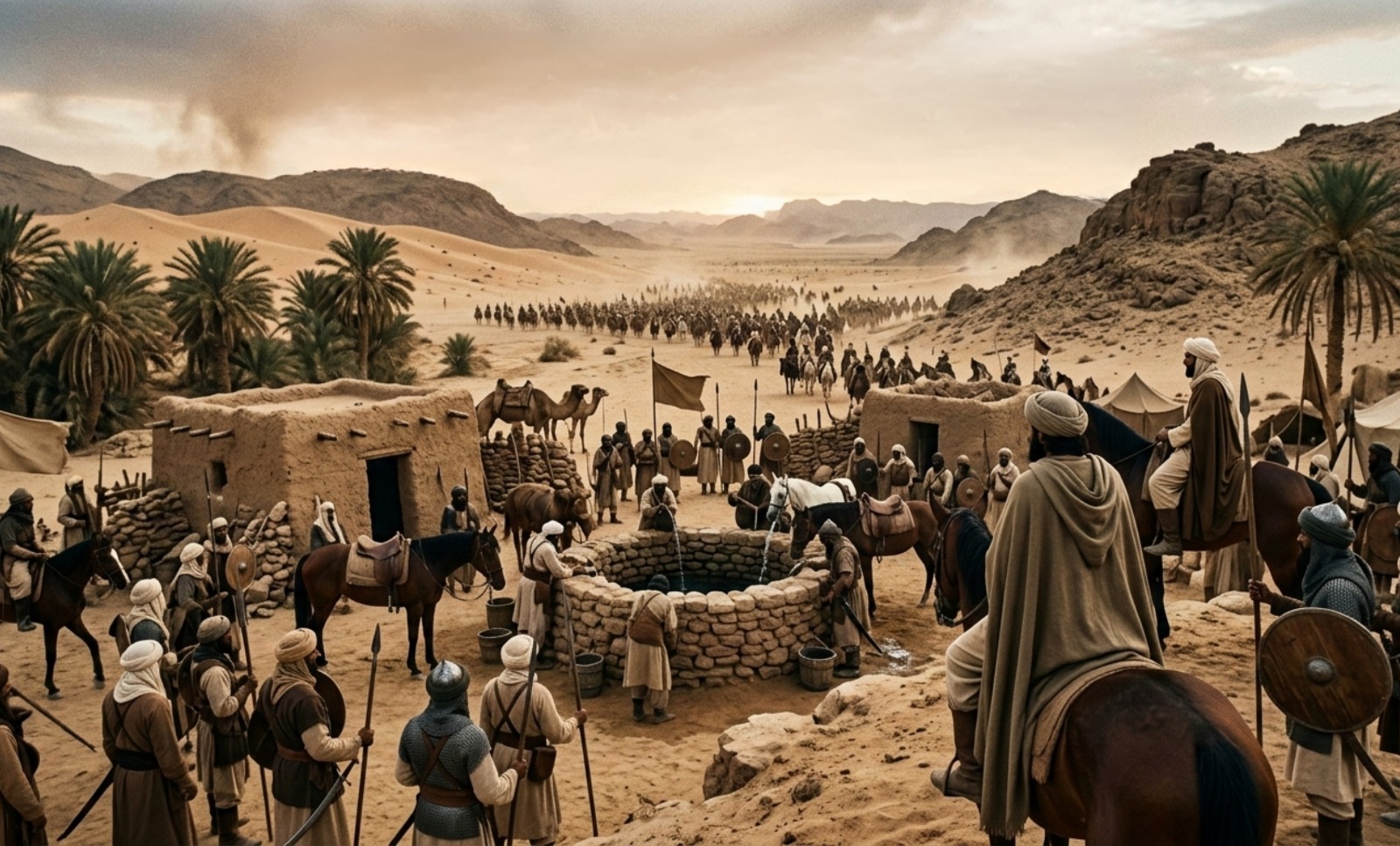
From the moment the Muslims left Madinah, the Prophet (PBUH) utilized scouts to track the movement of the Meccan caravan and the subsequent army led by Abu Jahl. This gathering of “intelligence” allowed the smaller Muslim force to choose the time and place of the engagement. In the harsh climate of the Arabian Peninsula, where the sun is as much an enemy as the sword, the most critical resource was not iron or horses—it was water. The “Strategy of the Wells” became the pivot upon which the entire battle turned.
The Wisdom of Hubab ibn al-Mundhir and the Principle of Shura
One of the most beautiful incidents of Badr involves the Islamic principle of Shura (consultation). When the Muslim army arrived at the valley of Badr, the Prophet (PBUH) initially chose a spot to camp. One of his companions, Hubab ibn al-Mundhir (RA), who was an expert in the geography of the region, approached him with great respect. He asked, “O Messenger of Allah, is this a place where Allah has ordered you to stay, such that we cannot move from it, or is it a matter of opinion, military strategy, and tactics?”
The Prophet (PBUH) replied that it was indeed a matter of human strategy. Hubab then suggested that the current position was not ideal. He proposed that the Muslims move to the well closest to the enemy, occupy it, and then fill in or cover the remaining wells. This would ensure that the Muslims had a constant supply of water while the Meccans, exhausted from their journey and the heat of battle, would be left thirsty. Without hesitation, the Prophet (PBUH) accepted this advice and moved the entire army. This moment highlights that in Islam, leadership is not about ego; it is about seeking the best wisdom for the community.
Logistics and Resource Management
The “Strategy of the Wells” was more than just a trick to make the enemy thirsty; it was an exercise in logistics. By controlling the water source, the Muslims could maintain their physical stamina. In 2 AH, the armor worn by soldiers was heavy and the desert heat was unforgiving. Dehydration was a silent killer on the battlefield. By securing the wells, the Prophet (PBUH) ensured that his men remained hydrated and focused, while the Quraysh were forced to fight not just the Muslims, but their own physiological limits.
Furthermore, the Muslims utilized their limited transport animals—70 camels and two horses—with incredible efficiency. They rotated riders so that everyone had a chance to rest. This “sharing of resources” meant that the 313 men arrived at the front lines in better physical condition than the larger Meccan force, which had traveled with luxury but lacked the disciplined resource management of the believers. This reminds us that in any struggle, success often goes to those who manage their limited resources with the most wisdom.
The Psychological Advantage of Strategic Positioning
Positioning at Badr also involved psychological warfare. The Muslims occupied the “near bank” (al-udwatun-dunya), which allowed them to see the enemy clearly while remaining somewhat obscured by the terrain and the morning sun. The Prophet (PBUH) also organized his men in ranks (Saff), a tactic that was relatively new to the Arabs of the time, who usually fought in disorganized tribal clusters.
By standing in disciplined, prayer-like rows, the 313 Muslims presented a formidable and unified front that intimidated the disorganized Meccan army. The strategic silence maintained by the Muslims, punctuated only by the rhythmic chanting of “Ahad! Ahad!” (The One! The One!), created an aura of invincibility. Strategy, in this sense, was used to magnify the presence of the small group, making them appear far larger and more powerful than they physically were.
Modern Application: Strategic Charity and Water Aid
The “Strategy of the Wells” at Badr provides a profound parallel for the work of Children of Adam today. Just as water was the strategic key to victory in the desert, clean water is the strategic key to victory over poverty in the 21st century. Without water, a community cannot have health; without health, children cannot attend school; and without education, the cycle of poverty continues.
When we build a water hand pump or a large-scale filtration plant, we are employing the “Badr Strategy.” We are securing the most vital resource for a vulnerable community, giving them the “water of life” they need to survive and thrive against the “armies” of disease and economic hardship. Furthermore, by following the principle of Shura, we consult with local communities to ensure our aid is placed where it is needed most. We honor the military genius of the Prophet (PBUH) by being strategic, efficient, and wise in how we distribute the “Zakat” and “Sadaqah” entrusted to us.
Frequently Asked Questions (FAQs)
What was the “Strategy of the Wells” at Badr?
It was a tactical decision to occupy the well closest to the enemy and block access to other water sources. This ensured the Muslims remained hydrated while the enemy army suffered from thirst and exhaustion during the heat of the battle.
Who was Hubab ibn al-Mundhir and why is his role important?
Hubab ibn al-Mundhir was a Sahabi with expertise in desert geography. His role is vital because he provided the strategic advice to change the army’s position. His story illustrates that the Prophet (PBUH) valued consultation (Shura) and expert advice.
How did the Prophet (PBUH) react to tactical advice from his companions?
The Prophet (PBUH) was extremely humble and open to advice. When Hubab ibn al-Mundhir suggested a better military position, the Prophet (PBUH) immediately accepted it, demonstrating that leadership in Islam is based on wisdom and the best interests of the group.
Why was water so significant in the outcome of the Battle of Badr?
In the desert, water is the most critical resource for survival. By controlling the water, the Muslims maintained their physical strength and morale, while the Quraysh became dehydrated and desperate, which contributed to their eventual defeat.
How does the Badr water strategy relate to modern charity?
It teaches us that providing essential resources like clean water is a strategic way to empower people. Organizations like Children of Adam follow this example by prioritizing water projects (Qutrah) as a foundation for community health and success.