The Meaning of the Day of Criterion
In the Quranic discourse, the Battle of Badr is not merely referred to as a military engagement; it is famously bestowed with the title Yaum-ul-Furqan—the Day of Criterion. To understand why a single Friday in the month of Ramadan, in the second year of the Hijrah, holds such a monumental status, one must look at the word “Furqan” itself. It refers to that which separates and distinguishes. On the 17th of Ramadan, Allah (SWT) separated truth from falsehood, light from darkness, and the monotheistic future of humanity from the polytheistic traditions of the past.
Before this day, the Muslim community in Madinah was in a state of constant vulnerability. They had been driven from their homes in Makkah, their properties had been seized, and their very existence was under threat. The encounter at Badr was the moment the scales were balanced. It was the day when the divine decree manifested physically on the earth, proving that a small group, when standing on the foundation of truth and justice, could overcome a much larger force built on arrogance and oppression. This title, “The Day of Criterion,” reminds us that truth is not defined by numbers or wealth, but by the divine support that accompanies sincerity.
The Arrival at the Battlefield
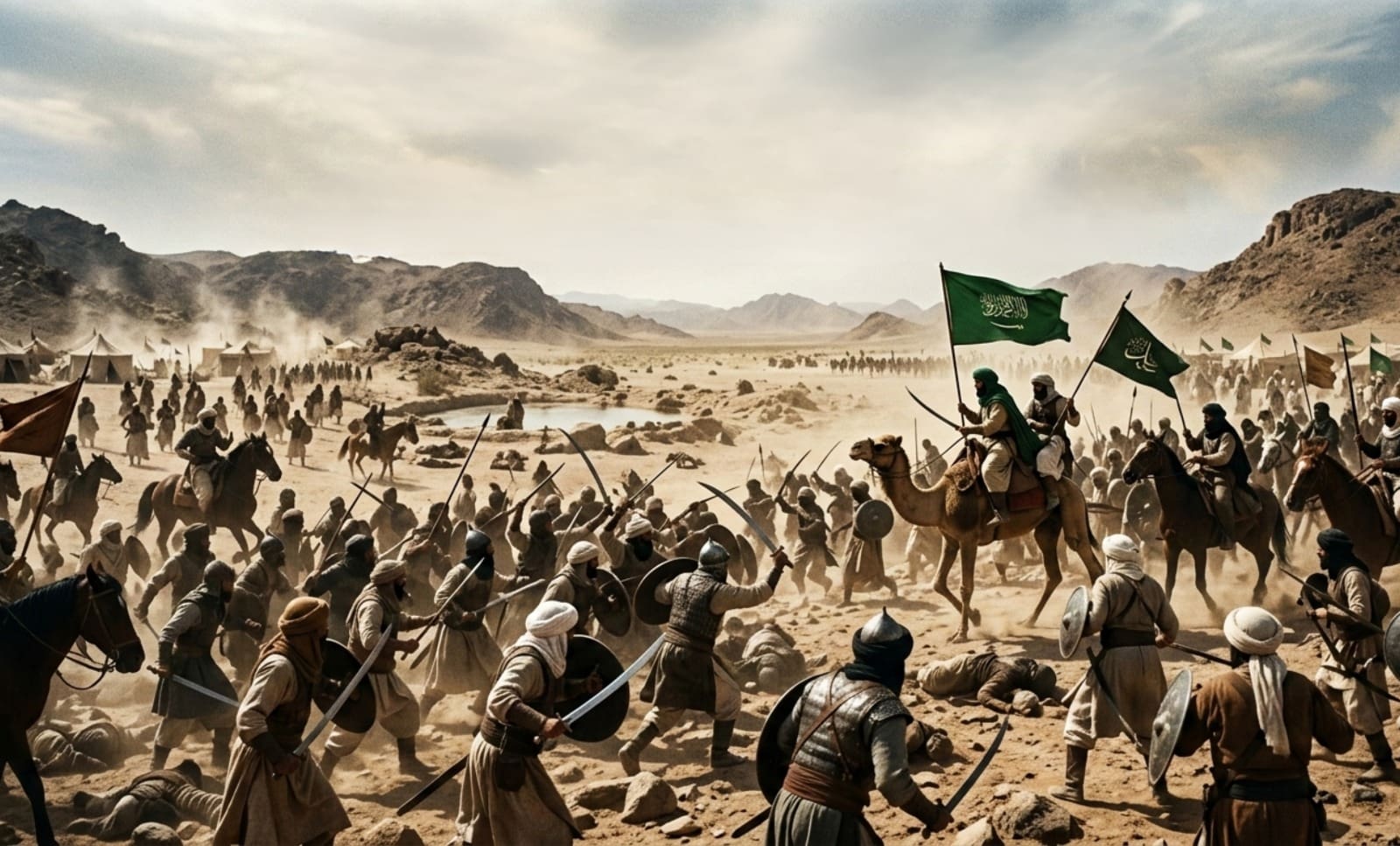
The atmosphere at Badr as the sun rose on that fateful Friday was heavy with destiny. The two armies were positioned at opposite ends of the valley. The Quran describes this scene in Surah Al-Anfal, noting the “near bank” where the Muslims were stationed and the “far bank” occupied by the Quraysh. Strategically, the Quraysh had the advantage of the better ground and access to more resources, but the Muslims had been blessed with a divine tranquility that permeated their ranks.
As the 313 Sahabah marched toward the valley, they were not just soldiers; they were the embodiment of a new world order. Many were fasting, though some were permitted to break their fast for the physical demands of battle. They were brothers-in-arms who had sacrificed everything—their families, their homes, and their status—for the sake of Allah. On the other side stood the elite of the Quraysh, led by Abu Jahl, who viewed the Muslims as a small, insignificant group that would be easily wiped out. This arrogance was the very thing that the “Day of Criterion” was set to dismantle.
Surah Al-Anfal and the Revelations of Badr
Much of the wisdom regarding Badr is contained within Surah Al-Anfal (The Spoils of War). This Surah was revealed to provide guidance on the aftermath of the battle, but it also reflects on the spiritual state of the believers during the conflict. Allah (SWT) reminds the believers that it was not their arrows that struck the enemy, nor their swords that brought victory, but the divine hand that orchestrated the triumph.
The Surah highlights the “Al-Anfal” or the spoils, teaching the Muslims that wealth and material gain are secondary to the pleasure of Allah. It established the rules of engagement and the treatment of prisoners, setting a standard for human rights in warfare that was centuries ahead of its time. For organizations like Children of Adam, these verses serve as a reminder that the ultimate goal of any struggle—whether on a battlefield or in humanitarian relief—is to establish justice and provide for the vulnerable, rather than personal or material glory.
The Legacy of the 17th of Ramadan
The 17th of Ramadan is now etched in the heart of the Islamic calendar. It is a day of reflection on the power of faith. While we often focus on the physical fighting, the true essence of Yaum-ul-Furqan lies in the ideological victory. It proved that the message of the Prophet (PBUH) was not a passing trend but a divinely protected truth.
The victory at Badr gave the Muslims the political and social standing needed to grow. It sent a message to all of Arabia that a new force had arrived—one that could not be bought or intimidated. This anniversary serves as a yearly reminder to the Ummah that even in our darkest moments, when we are outnumbered and outresourced, the “Criterion” remains with those who hold fast to their principles. The Friday of Badr changed the course of human history by ensuring that the light of Islam would never be extinguished.
Applying the Lessons to Modern Challenges
In 2026, the world faces different types of “battles.” We face the battle against extreme poverty, the battle for clean water, and the battle to protect the most vulnerable children. The lessons of Yaum-ul-Furqan are more relevant than ever. We learn that we must have the courage to stand up for what is right, even when the odds seem impossible.
When we contribute to Children of Adam, we are participating in a modern form of the “Criterion.” We are separating ourselves from apathy and choosing the path of compassion. Just as the 313 stood firm at Badr to protect the future of the Ummah, we must stand firm today to protect the future of those who have no one else to turn to. The victory of Badr teaches us that with Allah’s help, no mountain is too high to climb.
Frequently Asked Questions (FAQs)
Why is the Battle of Badr called “Yaum-ul-Furqan”?
It is called the “Day of Criterion” because it was the day that clearly distinguished truth (Islam) from falsehood (idolatry and oppression). It proved that the Muslims were divinely supported and that their message was the ultimate truth.
What was the exact date of the Battle of Badr?
The battle took place on the 17th of Ramadan, in the second year of the Hijrah (2 AH). In the Islamic tradition, this day fell on a Friday.
How does Surah Al-Anfal relate to the Battle of Badr?
Surah Al-Anfal was revealed largely in response to the events of Badr. It discusses the distribution of spoils, the spiritual lessons of the victory, and the importance of unity and obedience to Allah and His Messenger.
Were the Sahabah fasting during the battle?
The battle took place during Ramadan. While many Sahabah began the day fasting, the Prophet (PBUH) eventually advised them to break their fast to maintain the physical strength required for the intense combat they were about to face.
What is the main lesson of Yaum-ul-Furqan for us today?
The main lesson is that victory and success are not dependent on numbers, wealth, or weapons, but on the sincerity of one’s faith and the help of Allah. It encourages us to remain steadfast in our principles regardless of external pressure.