The Intersection of the Seen and Unseen
The Battle of Badr is uniquely characterized in Islamic history as a moment where the physical world and the spiritual realm converged. While the 313 Sahabah stood on the burning sands of the valley, they were not the only warriors present. The Quran and numerous authentic Hadith narrations confirm that Allah (SWT) sent a celestial army to reinforce the ranks of the believers. This divine intervention serves as a timeless reminder that when human effort reaches its limit, the assistance of the Creator begins.
For the small band of Muslims, the sight of a thousand well-armed Meccan soldiers was a daunting reality. However, their hearts were anchored by the promise of Allah. The arrival of the angels was not merely a physical reinforcement; it was a psychological and spiritual fortification. It transformed a desperate struggle for survival into a manifestation of divine justice, proving that the laws of physics and numbers are subordinate to the will of the Almighty.
The Descent of the 5,000 Angels
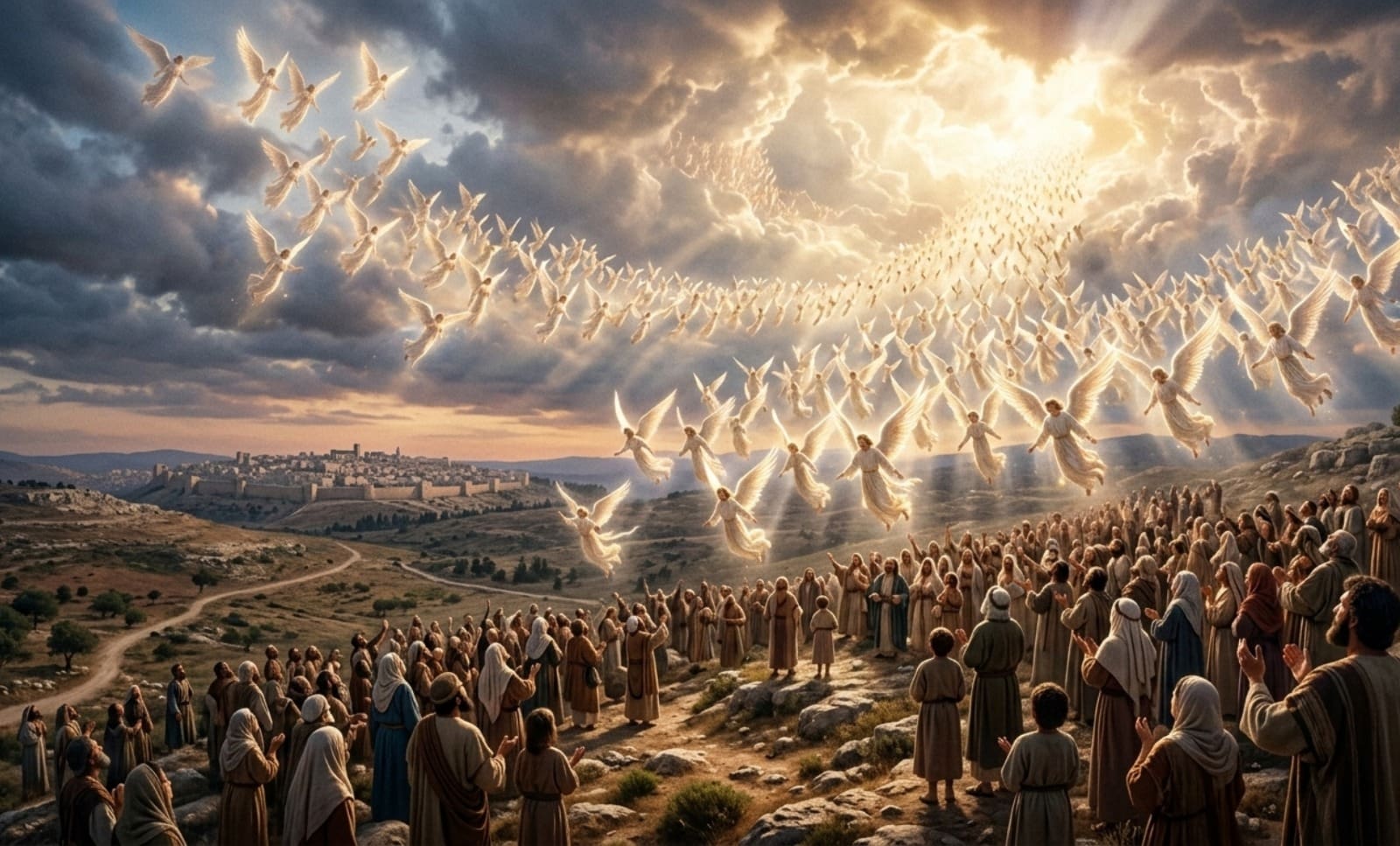
The Quran explicitly mentions the intervention of the angels in Surah Al-Imran, stating: “And already had Allah given you victory at [the battle of] Badr while you were few in number… [Remember] when you said to the believers, ‘Is it not sufficient for you that your Lord should reinforce you with three thousand angels sent down?’ Yes, if you remain patient and conscious of Allah and the enemy comes upon you [attacking] in rage, your Lord will reinforce you with five thousand angels having marks [of distinction].”
According to historical narrations, these angels did not appear as ethereal, ghostly figures. Many Sahabah reported seeing warriors on magnificent horses, wearing white turbans with the ends hanging down their backs. Some specifically noted that the Angel Jibril (AS) was present, leading the heavenly host. The primary role of the angels was to “strike terror” into the hearts of the oppressors and to “firm the feet” of the believers. While the Sahabah did the fighting, the angels provided the supernatural “Barakah” (blessing) that made every strike count and every move strategic.
The Miracle of the Handful of Dust
Beyond the descent of the angels, another profound miracle took place during the heat of the conflict. As the two armies clashed, the Prophet Muhammad (PBUH) took a handful of small pebbles and dust from the ground. He threw them toward the ranks of the Quraysh, exclaiming, “May these faces be disfigured!” What happened next defied the laws of nature. This small amount of dust did not simply fall to the ground; it was carried by a divine wind into the eyes, nostrils, and mouths of every single soldier in the enemy army. The Quran references this event in Surah Al-Anfal: “And you threw not, [O Muhammad], when you threw, but it was Allah who threw.” This moment of divine intervention caused instant chaos and confusion among the Meccan ranks, allowing the outnumbered Muslims to break the enemy’s line. It serves as a powerful metaphor for how a small, sincere action—when blessed by Allah—can have a global impact.
The Cloud and the Rain: Nature as a Divine Tool
Even the weather at Badr was a miracle designed to assist the 313. On the night before the battle, a gentle rain fell upon the valley. For the polytheists on the far side of the valley, the rain turned the ground into a muddy, slippery quagmire that hindered their movement. However, for the Muslims on the “near bank,” the rain served to pack the dry, loose sand into a firm surface, making it easier for them to stand and move during the fight.
Furthermore, the rain provided much-needed water for the Muslims to perform Wudu (ablution) and refresh themselves. The Quran describes this as a “mercy” from Allah to “remove from you the defilement of Satan and to tie with faith your hearts and keep firm thereby your feet.” This reminds us that every element of nature—from the wind to the rain—is a soldier in the army of Allah, working in favor of those who strive in His cause.
Modern Reflections: Seeking Divine Support Today
The miracles of Badr are not just stories from the past; they are a blueprint for how we should approach our modern-day challenges. When Children of Adam deports aid to a disaster zone or builds a water filtration plant in a remote village, we are often “outnumbered” by the sheer scale of the crisis. Poverty, famine, and thirst can seem like an invincible army of a thousand warriors.
However, the lesson of the 5,000 angels is that we are never alone in our sincere efforts. When we take a “handful of dust”—a small donation or a few hours of volunteering—and throw it toward the problem with a sincere heart, Allah can amplify its effect. Divine intervention in 2026 comes in the form of “Barakah” in our resources, the opening of doors that were previously closed, and the softening of hearts to support the needy. We do our part with the 313, and we trust Allah to send the support of His unseen forces.
Frequently Asked Questions (FAQs)
Did the angels actually fight in the Battle of Badr?
Yes, Islamic tradition and the Quran confirm that angels participated. Some narrations suggest they struck the enemy, while others emphasize that their primary role was to strengthen the hearts of the Muslims and cause fear and confusion among the Quraysh.
What was the “miracle of the pebbles” mentioned in the article?
This refers to when the Prophet (PBUH) threw a handful of dust at the enemy. Miraculously, the dust reached the eyes of every enemy soldier, causing them to retreat and lose focus, an event mentioned specifically in the Quran.
Why did Allah send angels if the Muslims were already brave?
The angels were sent as a “Bushra” (glad tidings) and to provide “Itmi’nan” (tranquility) to the hearts of the believers. It was a sign of Allah’s pleasure and a demonstration that ultimate victory belongs to Him alone, regardless of human strength.
Is there archaeological evidence of the Battle of Badr?
The site of Badr in Saudi Arabia is a well-known historical location. While thousands of years have passed, the topography matches the Quranic descriptions, and the “Graveyard of the Martyrs” (Shuhada al-Badr) remains a site of visitation and reflection today.
Does divine intervention still happen today?
While the era of Prophets and the physical descent of angels has ended, the concept of “Barakah” (divine blessing) remains. When Muslims work sincerely for the sake of Allah, He provides ease, protection, and success through means we cannot always see or explain.